Green Heart Guidance
  • Home
  • About Elizabeth
  • Specialties
    • Healing Trauma, Abuse and Loss
    • Health Challenges and Chronic Illness
    • Pregnancy and Infant Loss
    • Healing Messages
    • Pet Services
    • Remote Home Viewings
    • Green Living
    • Organic Eating and Food Sensitivities
  • Guidance
    • Consultation Fees
    • Classes
    • CEU Seminars
    • Client Forms >
      • Liability Form
      • Policies and Procedures Agreement
      • New Client Information
      • New Pet Client Information
      • Bereavement Questionnaire
    • Payment Options
  • Blog
  • Contact Me

The Pain of Birthdays

6/8/2015

0 Comments

 
The Pain of Birthdays by Elizabeth Galen, Ph. D.
For a long time as an adult, I did not celebrate my birthdays. This was because my deceased daughter’s birthday is only a few days away from mine, and it felt horribly unfair to me that I was getting to celebrate another birthday when she didn’t get to celebrate even one. It took many years of grieving before I finally reached a place where I was comfortable enough with my daughter’s death and to be able to celebrate my own birth again.

Once I had worked through my issues around my daughter’s birthday and was ready to celebrate again, I found out that there were other reasons that I hadn’t been celebrating my birthday, reasons that were almost as painful. What I rediscovered was that my now ex-husband doesn’t want to celebrate holidays, especially birthdays. He says that birthdays aren’t important to him, so he doesn’t do them. Even though they were very important to me, he wasn’t willing to budge on this one.

I talked to many therapists about this issue and about how hurt I was by my husband’s refusal to celebrate my birthdays in the way I wanted to celebrate. I’m not a person who needs or wants glamorous gifts. I don’t even need a store-bought card. I just need those around me to acknowledge that I am special and that they appreciate having me in their lives in whatever way they can. However, my ex-husband was so against birthdays that he couldn’t even do that. Unfortunately, most of the therapists I saw during that part of my life gave me very poor advice: they placed the blame on me, not my ex-husband, and said that the problem was mine alone, not his. They told me that he had made his position clear, and that I only had one option, to accept that he would never be willing to celebrate my birthdays with me. This only compounded my insecurities and made me feel like there was something wrong with me for wanting my partner to celebrate my birthday in some way.

Not surprisingly, I could not accept my ex-husband’s position of being unwilling to even say happy birthday to me most years. I felt as though I was being completely reasonable in wanting a partner who was willing to make that small amount of effort to show me he loved me. I also did have a choice, but it wasn’t one that my previous therapists presented to me: I could leave the marriage to find someone else who was willing to celebrate me as I want, need and deserve. There was absolutely nothing wrong with me wanting to get my needs met. I understand that the therapists were trying to teach me that we can’t change others: we can only control our own behavior. However, in trying to teach me that lesson, they missed the forest for the trees. There was a very fundamental problem in my marriage that went much deeper than the issue of birthdays.

Participating in marriage therapy with a really amazing therapist and reading books like The 5 Love Languages helped me recognize that in a healthy relationship, partners do things that they don’t always enjoy, but they do it because it gives pleasure to their partners whom they love. I certainly acted this way in my half of the marriage, doing things I didn’t really enjoy on a regular basis because I knew they would make my then-husband happy. I even asked the marriage therapist at one point, “Why is it that I always do things to make him happy but he’s not willing to do the same in return?”  For the first time in my life, the therapist gave a great response: “That’s a really good question!” The answer that he eventually helped me to discover was that when both partners aren’t able to meet each others’ basic needs from a romantic partner, it’s not a good relationship, no matter how much they love each other. In this situation and many others, my ex-husband and I were not well-matched, and divorce was the healthiest option for us based on our circumstances.

Now that the marriage has ended, my ex-husband still is unable to say happy birthday or happy mother’s day to me. I can accept it now, though I still wish it was different. I recognize that he has emotional issues of unknown origin from his past that interfere with his ability to celebrate both himself and others. While it certainly is his choice, it’s not my choice for how I want to live my life. There is too much joy to be shared in this world, and I’m grateful that I am now in a place that I can embrace that joy with those who love me and celebrate me on my birthday and on other days, too.

© 2015 Elizabeth Galen, Ph.D., Green Heart Guidance, LLC
0 Comments

Review of Living in the Light

6/7/2015

0 Comments

 
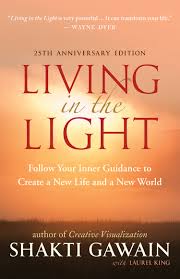
Review of Living in the Light by Elizabeth Galen, Ph.D.
Over the past few years, my life has changed a great deal. I am no longer the same person I was when I got Lyme disease, nor am I the person who suffered miserably with it in the early years. I’ve always been a fighter (or a “warrior” to use the more spiritual term), and that is part of what has helped me to defeat this disease. The spiritual transformation I experienced along the way is not an unusual story, though mine is unique, just like everyone else’s. However, as I worked my way thoughLiving in the Light over the past few months, I saw the generalized path I had walked laid out very clearly by a powerful author. As I turned the pages through the first chapters of the book, I kept thinking, “Yes, been there, done that.”

Living in the Light is about a different way of looking at one’s life than philosophies most of us were raised in modern Christian-dominated America. Gone is the judgment and fear of burning in hell that serves as the motivation in many Christian traditions. Instead, Gawain presents a vision of “a new world” that she sees developing around us. For her, life is a series of lessons to be learned as a we use our intuition to tap into the higher powers around us. By using our intuition, we can become creative channels for the higher powers of the Universe while we work on growing and improving our souls.

Along our road to growth, we have to learn to be truly open to whom we are. We need to become balanced beings who are able to give and to receive. To understand ourselves fully, Gawain argues that we need to face our “shadow sides,” a Jungian term for the parts of ourselves we are afraid of. It is only in accepting every part of our beings that we can find balance. This includes learning to embrace our emotions and face our problems. It also means recognizing that we are both souls and humans in bodily form, and we must live as both. Despite what many schools of thought might teach, our bodies are perfect, just as our souls are. Even though they have limitations, our bodies are amazing, and we need to respect them and listen to them in order to live healthy lives.

Shakti Gawain also discusses the concept of the world as our mirror: whatever we are struggling with inside of ourselves will also manifest externally. By paying attention to these synchronicities around us, we will be able to accelerate our healing and growth. Even though things around us may seem to be negative, they aren’t actually. Instead, what manifests in our lives are gifts for us to learn from; problems are actually messages if we are willing to use our intuition to listen to them. Our careers, our financial situation and even our health will reflect what is going on within us. Then, through the same mirroring perspective, the beneficial changes we make within ourselves will then be reflected throughout the world, too.

The most powerful chapters in the book for me were those on the male and female within which demonstrate that we all have both masculine and feminine energies within  us. The masculine side is the action side of us, the part of us that wants to do things. The feminine side is the intuitive side, the part that helps us find the correct direction to move in. Most of us have embraced one side at the expense of the other, but we all need to have both the masculine and feminine within us to be balanced in our lives. Like Gawain, I embraced my masculine side for the first 35 years of my life; in the more recent years, I’ve had to learn to accept, embrace and love my feminine side as well. As I have done so, I’ve found greater peace than I’ve ever known previously.

Working from this place of balanced masculine and feminine energies, Gawain demonstrates that romantic relationships in our culture have been built on theidea of romantic partners completing the other. Because we are not allowing ourselves to be both masculine and feminine, we end up in dysfunctional relationships because we want someone else to fulfill the part of ourselves we don’t accept or want to embrace. When we learn to be what we want rather than asking others to do it for us, we are able to enter into healthier relationships built on being complete individuals rather than partial ones. This new energy of balanced relationships will also spill over into our relationships with our children as parenting takes on a new perspective. By developing honest relationships and respecting our children, we will no longer expect our children to complete us either.

Living in the Light is not without its minor flaws. At one point Gawain refers to the Native American and African cultures. While an error like this might have been possibly have passed muster in the original edition of the book, the 25th anniversary edition that I was reading should have been edited to correct the better cultural understanding of our times. There is no one Native American culture. There are common elements shared by many different Native American tribes, such as a unifying belief in the sanctity of the Earth, but to speak of one particular Native American culture is lacking in perspective. Likewise, Africa is a continent that is over two million square miles larger than North America; Africa’s current population is double that of North America. To generalize that there is one African culture is completely missing the reality of the multitude of diverse cultures on the African continent.

The one place where I felt that Gawain hasn’t fully worked through her theories yet is in her discussion of “Taking Care of Ourselves” (chapter 14). Often as we as a society develop ideas, we swing between extremes. Think of the conservative 1950s, the liberal 1960s, and the more balanced 1970s. Here, Gawain has responded to the societal tendency to repress our emotions rather than facing them; she swings too far in the other direction by stating that by being honest about our needs and emotions, we will get we want most of the time. To me, this section feels too much like a distorted law of attraction. Unfortunately, honesty will not always get us what we want because those around us are individuals with free will, too. Some will chose to respond to our honesty by removing themselves from our lives rather than engaging honestly with us. Living and speaking honestly will change our lives, but we won’t necessarily get what we want. We will, however, get what is best for us by being honest.

It is rare that I recommend a book to a half-dozen people after I finish it, but that happened to me in the days after I finally finished Living in the Light. As I have begun my spiritual singles meetup, I have shifted the original plans I had for the group in order to use this book, asking participants to read a few chapters each month as we work our way through the larger concepts of the book. The material is that powerful and that helpful. I’ve included a huge list of book group or discussion group questions below that can be adapted as needed for your group. For mine, I’ll be dividing the questions over 20 sessions over eight months or so.

Living in the Light is a book I suspect that I will return to many times over my life, and I suspect it will always be a book that will give me helpful reminders and insight no matter where I am in my journey at that point. Even as I read it the first time, I found that synchronicity prevailed, and whatever I read was exactly what I needed to hear at that particular moment.

© 2015 Elizabeth Galen, Ph.D., Green Heart Guidance, LLC

Living in the Light Book Group Questions
File Size: 224 kb
File Type: pdf
Download File

0 Comments

Marriage is an Edifice

6/7/2015

0 Comments

 
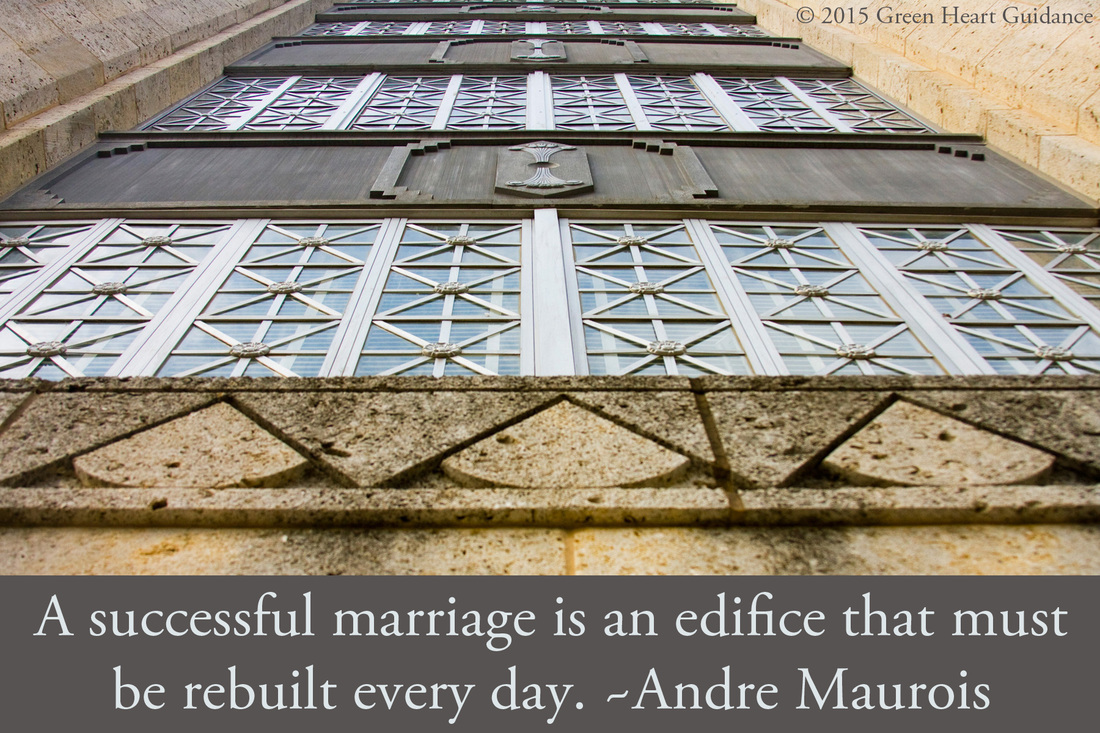
A successful marriage is an edifice that must be rebuilt every day. ~Andre Maurois
photo taken at the Travis County Courthouse
0 Comments

A Spiritual Union

5/28/2015

0 Comments

 
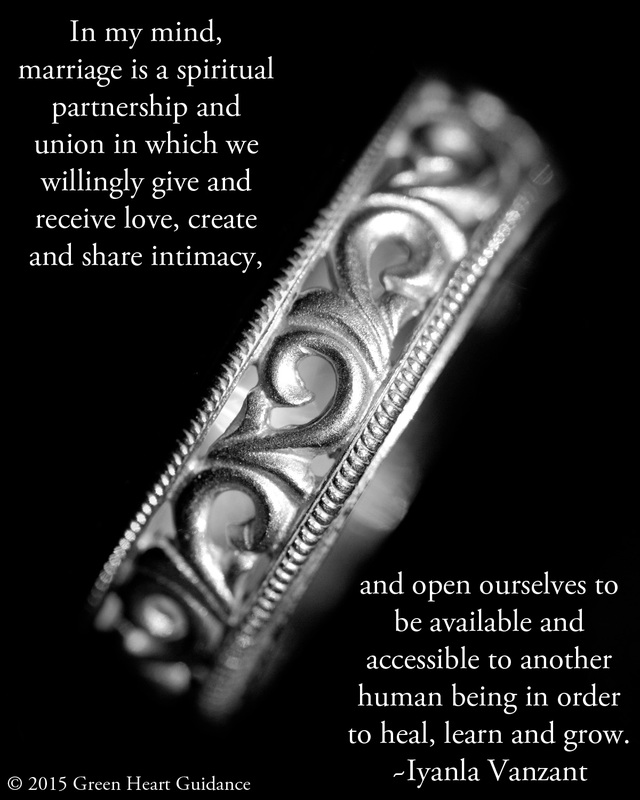
In my mind, marriage is a spiritual partnership and union in which we willingly give and receive love, create and share intimacy, and open ourselves to be available and accessible to another human being in order to heal, learn and grow. ~Iyanla Vanzant
0 Comments

Co-Parenting Day

5/28/2015

0 Comments

 
Co-Parenting Day by Elizabeth Galen, Ph.D.
When my ex-husband and I were separated but not yet divorced, the date of our wedding anniversary became problematic for me. It wasn’t our anniversary any more in spiritual terms: We’d cut the ties between us and knew that we weren’t going to stay married. Yet in another sense, it was still our anniversary, and it always will be. We got married on May 28th, and that would never change. It was a very special date in my life for a long time.

When I brought this issue to my friends on Facebook, a powerful discussion came forth. What they helped me realize is that there were things from our former relationship that were still worth celebrating, most importantly, our three living children whom we continue to raise together. We share custody equally along with making joint medical, education, and other important decisions about our children. My ex-husband and I still very much have a relationship that centers around our children, one that legally will continue for another 6+ years and probably beyond.

In light of our co-parenting relationship, my friends dubbed May 28th “Co-Parenting Day,” a far more positive statement than “our former anniversary.” Each year on this day, rather than mourning what used to be between us, I celebrate the children we have raised successfully first as a couple and then as divorced individuals. I am eternally grateful to my friends for helping me create this new celebration, one that reminds me of the good things that came from and continue to come from my partnership with my ex-husband.

Happy Co-Parenting Day!

© 2015 Elizabeth Galen, Ph.D., Green Heart Guidance, LLC
0 Comments

Review of The Perfect Letter

5/24/2015

0 Comments

 
Review of The Perfect Letter by Elizabeth Galen, Ph.D.
I admit that if it weren’t for Chris Harrison’s connection to The Bachelor/ette, I wouldn’t have put his first novel on my reading list. In fact, if I hadn’t gone tothe book signing last week, I probably would not have bought the novel at all. Instead I would just have waited to borrow it from the local library once it finally became available there in digital format. Yet in spite of those facts, I’m grateful I did purchase The Perfect Letter because the book captivated me fairly quickly: I ended up reading it all on one rainy book-reading type of Saturday, not wanting to put it down to deal with any of the pesky necessities of life that arose. Harrison’s writing style is highly descriptive and emotionally gripping. While the story is one that describes lives lived outside of the ordinary, the realism of the relationships between the characters makes the novel seem almost possible. Harrison definitely did not write a book that was just a superficial romance but instead gets deeply involved with the emotions and psychological flaws of his characters. I was impressed with how often Harrison chose words that reflect the impact of our emotions onour bodies such as the “stone of guilt around her neck had become a weight so permanent it left her crippled“ or the “sudden feeling of grief squeezed her, took her breath away” (130, 201).

When I bought this book, I worried that this might be the stereotypical romance novel: the gorgeous woman with the perfect life including the Harvard degree, the amazing career and the dream New York apartment dates the perfect but boring man and wants something more. Yet as I read the first love scene, such as it was, I felt that internal pang that occurs when I read something that feels all too real in relation to what I have experienced in my life. This “perfect” relationship of Leigh Merrill with Joseph Middlebury was anything but. From only a few pages into the novel, Joseph appears to use Leigh for the attention she can give him and the ways in which she can meet his needs. Her desires take a backseat in the relationship. While there was love in the relationship between Leigh and Joseph, there also were a lot of deep and problematic issues as well. When Leigh talks about Joseph to others, she becomes immediately defensive in that way so many of us are prone to do when we know there is truth in what others are saying to us yet we don’t want to see the reality.

Enter Jake Rhodes, a former boyfriend with whom Leigh experienced a tragedy ten years ago in the Hill Country of central Texas. When Leigh returns to the Austin area as a big city editor and keynote speaker for a writer’s conference, she and Jake reconnect out of a need to find closure with regard to their past. Jake is the opposite of Joseph in so many ways: he doesn’t have an amazing career, but he is a romantic and his love for Leigh is unconditional. Harrison slowly unfolds the story of what happened to the two when they were teens, a combination of their love story and their tragic past. As Leigh and Jake reunite after their ten year separation, their love and their passion is still as strong as ever despite the wounds that have hurt them. When a new challenge arises in their lives (aside from the obvious one of Leigh’s serious romantic involvement with Joseph), the two have to decide how to handle both their past and the future.

For having such a great verbal grasp on the fine details that can color a book, some of the situations in the book became clichéd. In trying to set the scene firmly in the Austin area, Harrison mentions bats and bluebonnets far more often than necessary. He also repeatedly sings the praises of Guero’s (Bill Clinton ate there!) though many locals will tell you that it’s overhyped nowadays. In addition, the not-so-trivial detail of birth control and sexually transmitted disease prevention falls by the wayside (just as it does on The Bachelor/ette). While I know many romance novels ignore such practicalities because they feel it takes away from the passion of the moment, in a novel with as many details as this one, the absence felt glaring to me especially as two teenagers seemingly engage repeatedly in unprotected sex with no consequences. Despite these small issues, the book is an overall strong effort that is well worth reading.

At the book signing I attended, Chris Harrison was clear that he wants this book to be made into a film; he asked the audience to start thinking about who should play the leads. I can easily see this novel being turned into a movie filmed in the Texas Hill Country and attracting an audience of men and women alike because of some of the high-paced action it contains along side the romance. I also look forward to Harrison’s future works, and I will definitely be picking them up when they release!

© 2015 Elizabeth Galen, Ph.D., Green Heart Guidance, LLC
0 Comments

"Parents, Not People"

5/23/2015

0 Comments

 
Carrie Bradshaw and Sebastian Kydd
In an episode of The Carrie Diaries (1:11), Carrie Bradshaw’s boyfriend Sebastian is dealing with his narcissistic mother who sees him as her emotional dumping ground. She is the type of woman who attracts drama and then uses the emotional fallout to gain attention from others including Sebastian. After having recently dealt with one of his mother’s crises, Sebastian profoundly states, “No one wants to have to get involved in their parents’ personal lives. We want them to be parents, not people.”

As the daughter of a narcissistic mother, I agree with this statement. When I was growing up, my mother was basically friendless. I don’t ever remember her going out with the girls. At one point, she joined a non-denominational Bible study group with neighbor women, but aside from that, I don’t remember her having friends. As I became a teen, my mother eventually became closer to her youngest sister who was 11 years her junior and in a dysfunctional marriage just as my mother was. However, having that one sister to bond with didn’t really fill the needs my mother had for attention from friends. Instead, she used me as her emotional outlet. When she felt the need to talk to someone, occasionally about topics that really belonged in a therapy session with a professional, she instead made me the one who had to listen to her issues.

Sebastian is correct in saying that we want our parents to be parents, not people. We want our parents to take care of us when we are young. We don’t want to have to take care of them, especially as young children or teens. That includes not wanting to be our parents’ confidantes. It’s just not appropriate or healthy for parents to use their young children as friends or therapists. Our children need to be children, not our support systems.

So does that mean we should not let our children know how we are feeling? Absolutely not. Children do need to know that their parents have emotions and feelings. Parents are not stoic statues who can handle anything without it affecting them. Children need to know that all people, including parents, have feelings, and that it is ok to experience emotion. The fine line that parents need to be careful not to cross is making sure that they don’t share inappropriate information. It’s ok for children to know parents are upset about a break up; children don’t need to know the explicit details of the sexual affair that led to the end of the relationship. This is especially true in cases of divorce. It is very difficult and damaging for children to hear their parents speak negatively of their other parents, no matter how true the statements are.

The opposite extreme of this narcissistic point of view where a parent tells a child too much is in the parent who tells a child nothing. This is almost if not equally as dysfunctional. Children are people, albeit less mature ones. They are able to sense when something is amiss in their home. They can tell when parents are upset or happy or under stress. Many children, not understanding the reasons for their parents’ emotional states, will blame themselves for the negative vibes they pick up. This is easily prevented by simply telling children the simple truth such as “I had a bad day at work.” The children don’t need all of the gory details of the parent’s day, but they do deserve a basic understanding of why their parents are acting and feeling as they do.

The fine line for parents between telling their kids too much or too little is a difficult one to navigate. Despite children possibly wanting them to be “parents, not people,” parents are people, too. Parents experience emotions and stress. However, children are not therapists, and parents need to remember to maintain appropriate boundaries when talking with their children.

© 2015 Elizabeth Galen, Ph.D., Green Heart Guidance, LLC

0 Comments

Long Distance Relationships

5/17/2015

0 Comments

 
Absence from whom we love is worse than death, and frustrates hope severer than despair. ~William Cowper

In episode 9, season 2 of The Carrie Diaries, Carrie and her boyfriend Sebastian briefly enter into a long distance relationship. Carrie’s boss Larissa (who has just declared her love for her engagement ring to be greater than her love for her fianc
é) discusses long distance relationships with her:
Carrie: In three months I’ll still be dating Sebastian. I know long-distance can be challenging.
Larissa: Sorry, but the moment that taut, muscular Goldilocks packed his bags, that relationship was doomed.
Carrie:You’re wrong about me and Sebastian. We’re gonna be--
Larissa: You’re gonna be the exception, yeah. That’s what everyone says. But first it’s a few missed calls. Then it’s a few missed weekends. Then, you’re not bothering to call at all.
Carrie: Well, that’s not gonna be us.
Larissa: Or worse, one of you moves for the other.
Carrie: Why would that be worse? That would be great.
Larissa: Mnh-mnh. Moving puts way too much pressure on the relationship. After that, they start resenting you for every little thing that goes wrong….
Carrie: Well, both of us are still in high school, so I don’t think either one of us will be moving anywhere for each other.
Larissa: So then it’s the slow ride into no relationship for you two. That’s a shame.
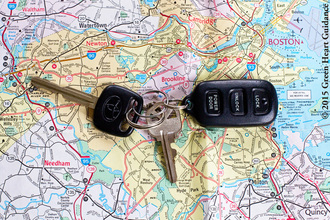
Long Distance Relationship by Elizabeth Galen, Ph.D.A map of the greater Boston area where I lived in 1993-94; my fiancé was in Houston at the time.
For better and for worse, my life has included four school years and a summer of a long distance relationship mostly during college with my then boyfriend/fiancé whom I eventually married and divorced. I spent years dealing with the negative comments about long distance relationships from others similar to the conversation quoted above. It was truly discouraging to have to deal with the negativity. I was told over and over again that long distance relationships never work. Some of my ex’s family made it very clear they didn’t want us to continue dating long distance because it was not “appropriate” for people as young as we were. Almost everyone else had a story to warn us about: the cheating, the growing apart, the difficulties in making it work, etc. No one seemed to have anything positive, helpful, or encouraging to say about long distance relationships.

The general population has some good points on this one. Long distance relationships are hard. There’s no question about that. If a couple isn’t meant to be, a long distance relationship where you no longer have physical or sexual interactions occurring regularly will cause relationships that are only built on physical chemistry to implode really quickly. The reality, though, is that the vast majority of those relationships would have ended eventually. The trial of the distance simply speeds up the breakup. My first college roommate was dating her high school boyfriend long distance for the first few weeks of school. She went home to visit one weekend and found condoms in the glovebox in his truck; she was on the pill so they no longer used condoms. That was the end of what was already a very unhealthy relationship that wouldn’t have lasted for long anyway. The physical distance just helped bring about a swifter end.

For me, the reality of the long distance relationship wasn’t what I’d expected. It was hard and painful, but it was doable. Neither of us was tempted to cheat, and our growth really continued along a similar pattern at that point in our lives. We were two bright, intelligent and communicative people. We turned to letter writing and eventually email to fill the distance. Phones existed, though the amount we spent on long distance bills (especially for the two years they were at higher in-state rates) was unbelievable. I often wonder how different things would have been for us in today’s day and age of cell phones with unlimited long distance and texting for $25 a month!

The bigger problem for us with long distance was something that I didn't see then but which actually was a huge red flag that would play out later in our relationship. Hindsight is always much closer to 20/20 than the present moment! The problem was that my ex actually didn’t mind the distance between us. He liked having a girlfriend who only stopped by once a month. He got all of the perks of a romantic relationship but far less responsibility or the feeling of being tied down. The space between us was actually an asset that never bothered him much. For me, however, it was devastating to be apart from him so much. I hated that I was always the third of fifth wheel in the group of friends I hung out with because my boyfriend was in another city or state. In retrospect, I realize that the long distance relationship actually may have kept us together rather than breaking us apart like it did for many others. The freedom my ex got during those long distance years was exactly what he needed even though it was horrid for me. Twenty years later when we ended our marriage, he was actually very excited about having his own place again whereas I was initially not happy about the idea of living alone. For all the horror stories and warnings people felt all too free to give us about long distance relationships, no one warned us that it might help keep us together when we might have been better breaking up!

Long distance relationships are hard. If there was another option, I wouldn’t advise people to choose the long distance except for short time periods or extreme circumstances. However, couples have been engaging long distance relationships for millenia: Military personnel and their spouses are a prime example. The bottom line is that long distance relationships are just not fun. The hot passion of reunions is fabulous, but the price to pay for it is just not enough to compensate for the pains of absence. A long distance relationship will help a couple discover the weaknesses of their relationship at a much faster pace than they would otherwise discover those issues. But when you take into account how many relationships break up over the course of a lifetime, both before and after marriage, a relationship ending during a time of long distance is not that much of a surprise. Long distance relationships just get a bad reputation for the wrong reasons.

© 2015 Elizabeth Galen, Ph.D., Green Heart Guidance, LLC
0 Comments

Parental Pressure to Join

5/14/2015

0 Comments

 
Parental Pressure to Join by Elizabeth Galen, Ph.D.
A popular but misguided parenting idea in our society is that parents should force their children to engage in extracurricular activities whether the kids want to participate or not to “broaden their horizons.” In my view, this is a horribly dysfunctional approach to parenting. The basic problem with this approach is that it fails to respect that children are humans who deserve to be treated as individuals with opinions, desires, and needs. While it is one thing to ensure that our children have access to extracurricular activities that they enjoy, it’s another thing altogether to force them to do things they really don’t want to do. As adults, most of us know what we like and what we don’t like. We don’t want others forcing us into activities that we don’t enjoy. Why should we do the same to our children?

When I was in middle school, my narcissistic mother got it into her distorted thinking that I *had* to join sports teams. I am not naturally athletic, nor are any of my parents or relatives. Rather, most of my lineage has two left feet and is lucky to walk without hurting ourselves! Yet despite this obvious fact, my mother had created a fantasy of her daughter as an athlete. Against my protests, she signed me up for softball through our church where I occupied the bench for most of the game and was stuck in the outfield for the inning I played so that I’d had a mandatory minimum turn in each game. My mother also signed me up to play basketball through my school where I was ridiculed by my classmates for how bad of a player I was. Again, I made a great bench warmer. After the second year, I am pretty sure the coach told her not to sign me up again because it was hopeless.

By the popular theories of parenting, these experiences in athletics should have taught me to enjoy something new or should have created positive childhood memories or given me an appreciation for athletics as my horizons were broadened. Yet 25 years later, I’m pretty sure the experiences in sports only taught me that I would never force my children to belong to an organization that they did not want to join. I have always respected their wishes. If they felt that something wasn’t for them, I would honor their opinions. All my children hate P.E. as much as their father and I did when we were younger, and none of them have joined any sports teams. That’s ok by me. They have other interests that they pursue that meet their dreams and desires.

In a similar vein, my mother decided when I was in eighth grade that I needed to take cotillion (a form of high society dance classes) at a local all-boys’ school. At the age of 12, I had absolutely zero interest in boys as members of the opposite sex. I also had no interest in dancing. Between the verbal abuse of my mother which had made it clear to me I was fat and the ridicules of my classmates for being a size 14, I had no desire to be put in a situation that would put my body on display in any way. In the one and only time I intentionally pitted my parents against each other, I asked my father to make mother back off about cotillion. I knew full well that my father hated dancing and that he never would force me to do something involving dancing. And as I expected, my father told my mother that she was not allowed to force me to attend an event at a boys’ school that I didn’t want to attend. Fortunately, the fallout between them was not nearly as dastardly as I feared.

Only a year later, my mother decided that I needed to have boys in my life so that I could start dating. This time she selected the church youth group as my mandatory “must join” activity. I flat out refused. I had no desire to join a group that included classmates from my former public grade school where I had been miserable. The high school youth group at the church had a lot of dances and athletic activities which were still of no interest to me. So I stood up to my mother, and I actually won. A few weeks later, a friend invited me to attend a co-ed discussion group at a local boys’ school (the same one that held the cotillion). This was far more up my alley: Sitting around and having intellectual conversations worked for me. Not long thereafter, I met the guy who became my future husband through the discussion group. Despite my mother’s unfounded fears that I would never find a boyfriend, when given the space to develop and explore on my own terms, I found a group that provided me with my closest friends during high school and the future father of my children.

Unless a child has become completely anti-social, parents need to take the child’s desires into account. For children who are introverts, the activities their extrovert parents might enjoy are actually terrifying for them. Likewise, just because a parent loves a particular sport doesn’t mean that their child will like it or even learn to like it. In my opinion, the best way to get children involved in extracurricular activities is to allow children to pick from a large range of things. If your child loves music, let them pick an instrument to take lessons. If your child loves to build contraptions, a robotics club might meet their needs. And even if you had dreams of taking your daughter to her dance recitals, if she shows interest in cross country, then encourage her to participate in things that make her happy. Our job as parents is not to force our children to live out our dreams: It’s to support our children in living theirs.

© 2015 Elizabeth Galen, Ph.D., Green Heart Guidance, LLC

0 Comments

"You Complete Me"

5/12/2015

0 Comments

 
There's something depressing about a young couple helplessly in love. Their state is so perfect, it must be doomed. They project such qualities on their lover that only disappointment can follow. ~Roger Ebert

A few months ago, I watched
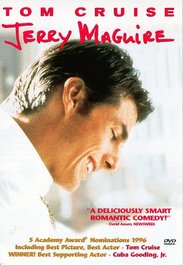
Jerry Maguire with my older kids. When the movie was first released in 1996 when I was 22 and a relative newlywed, I thought it was funny and romantic. This time around, my perspective was very different. Instead of seeing Jerry and Dorothy as a great couple, I saw them as two very damaged individuals who were making a big mistake in entering a relationship with each other. The movie’s (possibly) most romantic moment, shown below in a video clip, is when Jerry declares his love to Dorothy by telling her, “You complete me.”

Our culture is attached to this very distorted idea that we can complete someone else. Romantic relationships are supposed to help us find our other half, or in joking terms, our better half. We are supposed to find the magical person who helps us become better than we already are. Without them, we are incomplete. Unfortunately, creating this kind of unrealistic expectation lays the groundwork for dysfunctional relationships. We expect our significant others to be miracle workers who will magically improve us while we simultaneously are able to fulfill everything they need to be better people, too. As our astounding relationship grows, it becomes the epitome of perfection. We are the perfect couple because we complete each other.

And yet somehow this amazing relationship often ends up in divorce court. It turns out we don’t actually complete each other. What we often do is that we bring our individual flaws into a relationship where we can continue to grow in combination as each of us play off of the others’ weaknesses and strengths. We manage to pick partners whose family relationships and life experiences will complement our own so that we can continue to learn the lessons we are meant to learn in this life. Eventually, we realize that our dream partners aren’t whom we thought they were. They are not the ones to complete us.

So how do we find the person who actually completes us? We look inside. The only person who can make us whole is our own selves. We are the ones who can love ourselves. We can grow. We can change. We can become whomever we want to be (within realistic expectations, of course. There’s no chance of me becoming an NBA player any time soon). Rather than looking for someone else to fix us, it is up to each of us to do our own work. That work can and often does involve our romantic partners. We can grow and learn with each other. However, it’s when we expect our partners to fill in the holes within us that we enter the world of dysfunction. If we can’t be something we want to be, we can’t expect someone else to be it for us. Some people even shove this unhealthy expectation onto their children when their partners fail to complete their unrealistic dreams.

If I had to make a guess on Dorothy and Jerry’s romance, I’d say that they are likely to be in marriage therapy within a few years and divorced soon after. They both are individuals bringing in mountains of baggage and expecting that the other will somehow make all those issues suddenly disappear in their “completeness” as a couple. In reality, they are setting themselves up for heartbreak: When the novelty of the relationship wears off, they will instead find themselves even more broken and incomplete than before.


© 2015 Elizabeth Galen, Ph.D., Green Heart Guidance, LLC
0 Comments

Bitter Blessings

4/27/2015

2 Comments

 
Bitter Blessings by Elizabeth Galen, Ph.D.
I thank God for my handicaps, for, through them, I have found myself, my work, and my God. ~Helen Keller 

One of the ironies of human life is that some of the most painful things we experience end up being incredible blessings in the long run if we can look at them through the right lens. For me, Lyme has been one of those bitter blessings. Enduring the struggles of late disseminated Lyme disease has been one of the hardest challenges of my life, far worse in ways than going through a divorce, earning a Ph.D. or even having a child die unexpectedly from natural causes. I have been through a very difficult twelve year war with Lyme that has involved being bedbound, homebound, misunderstood, and in hellish physical pain. Yet despite the misery that I have endured because of Lyme, I see it as having been a catalyst for many other incredible blessings in my life.

The stress that Lyme placed on my former less-than-healthy marriage was what dealt the final death blows to the relationship. However, without the influence of the Lyme, I probably would have stayed in a marriage that was less than satisfactory because I was blinded from the reality I was living in. Lyme helped clarify how dysfunctional and unsupportive of a relationship it was and how the relationship wasn't built to sustain those vows of “in sickness and in health.” While the end of the marriage was deeply painful, I am far happier since I separated from my ex-husband than I was in most of the relationship with him. I am very grateful to be able to say that I am happily divorced.

Because I was so sick with Lyme, I was bedbound for the better part of two years and homebound for six. The isolation resulting from the illness has been a huge part of my growth.  As Shakti Gawain writes in Living in the Light:

When we, as individuals, first rediscover our spirit, we are usually drawn to nurture and cultivate this awareness.  This often involves withdrawing from the world to one degree or another, and going within.... Often it's a time of partial or complete withdrawal from relationships, work, and/or other attachments that pull us outside of ourselves....If we choose to follow one of the traditional spiritual paths we may remain more or less withdrawn from the world.  In this way we can be true to our spirit and avoid dealing with the attachments and patterns of our form.  Unfortunately, we never have the opportunity to fully integrate spirit and form.  In order to create the new world, we are being challenged to move out into the world of form with full spiritual awareness.
For me, the severity of the illness I endured forced me to have this time of isolation when I could grow without the overwhelming influence of the external world. While I still had access via the internet, I also spent a great deal of time in silence, and that was crucial to my healing. Now that I have been able to regain health, I am challenged to take my acquired knowledge into the world to help others.

Lyme has also forced me to me evolve spiritually. I would never have walked down the path I am now on if it hadn’t become a vital component for me to regain my health. I would have continued to spend my life, as I did in many previous lives, denying my metaphysical gifts out of fear of rejection and ridicule by those around me and in our society at large. Yet when accepting and using these gifts allowed me to heal when all else had failed, suddenly it no longer mattered what anyone else thought. I needed to be me, and I needed to help others to heal and be themselves, too.

Like any major illness, enduring Lyme for so long showed me what truly matters. I no longer take for granted things like going to the grocery store. I view it as a privilege, not a task. I no longer have an overwhelming need for material objects in my life; whenever I have a burst of health, I tend to use it to clean and purge as I’m still digging my way out from 12 years of accumulated clutter (partially due to living with a packrat and partially due to my inability to do anything besides the basics when I was so sick). I was never an incredibly materialistic person, but now, I’m even less so. Those things that used to bring me happiness no longer seem relevant.

I have also discovered who my true friends and family are. I believe strongly that family is the group of people you turn to both when you want to celebrate and when you want to cry. For many of us, those people aren’t our biological relatives. We create family where we can find it. We adopt families who accept us and love us exactly as we are. I definitely believe this is true for me. I have lost many friends along the way of my journey with Lyme, but I have also gained some new ones who are more amazing than I could have previously imagined.

So does this post mean that you should tell people who are going through some terrible trials that they are blessings in disguise? Absolutely not, unless you want to lose friends or risk life and limb with their reactions! Not everyone is in a space to be able to understand that their trials may eventually turn into blessings. Instead, the best response to people who are undergoing difficult times is simply to tell them that you’re happy to help them in whatever way would best serve them. Until they reach the point that time has helped heal their wounds and allows them to see what they have gained through their pain, the best thing to do is acknowledge their pain and offer loving compassion.

© 2015 Elizabeth Galen, Ph.D., Green Heart Guidance, LLC
2 Comments

When Exercise Isn’t the Answer

4/24/2015

0 Comments

 
When Exercise Isn’t the Answer by Elizabeth Galen, Ph.D.One of my sons' favorite pair of tennis shoes before I insisted they really were dead. This is what life with CFS can feel like, and you can't go to the store to get a new body very easily!
(As always, I am not a medical doctor. This information is based on my personal experiences and should not be substituted for medical diagnosis or treatment. Please speak to your health care providers about your personal situation.)

Everyone knows that when you exercise, you might feel tired initially, but all those endorphins you get pumping through your body will help you feel better in the long run. Soon exercising will increase your energy. Right? Wrong! This may be true for the majority of the population, but for those fighting chronic fatigue syndrome (CFS, also known as myalgic encephalomyelitis and systemic exertion intolerance disease) or Lyme disease,* the exact opposite may be true. Exercise has the potential to make these groups of people VERY sick for several days after they attempt to exercise.

This negative response of the body to exercise in the CFS population is known as post-exertional malaise (PEM). Studies have shown that PEM is not an exercise phobia: It is a physical response in those with CFS that does not exist in the healthy but sedentary control populations. While there are contradictory studies regarding fatigue related to CFS, they are problematic in their methodology because they aren’t evaluating patients the day after the testing to follow through: A study by Keller et al has demonstrated how the contradictory studies that aren’t evaluating the correct information on people with CFS and exercise impairment may overestimate the patients’ functionality by 50%. Thus, some patients with CFS can do well on a cardio test, but the next day, they won’t be able to move. Another study by Van Ness et al showed that 85% of the general control population had recovered from testing exercise 24 hours later, but ZERO percent of the CFS population had. That’s a huge difference in the world of statistical validity.

In addition, these studies that have patients doing 15+ minutes of cardio exercise are studies on the best coping patients in the CFS population. These are the people who complain that their CFS limits them to less than eight hours of activity a day as opposed to the people who, like I was previous for two years, are bedbound and unable to do more than take a shower and sit up for an hour daily. The worst of the worst in the CFS population are too sick to even consider participating in studies like these! They are the people who are counting their spoons very carefully, and they can’t spare energy for anything beyond basic bodily needs.

PEM is a hallmark of mitochondrial dysfunction for those in the CFS population. Dr. Amy Myhill was one of the first to develop a protocol to address the role of mitochondria in CFS, a protocol I tried in 2007 or so with limited success. As Myhill describes it:

The job of mitochondria is to supply energy in the form of ATP (adenosine triphosphate). This is the universal currency of energy. It can be used for all sorts of biochemical jobs from muscle contraction to hormone production. When mitochondria fail, this results in poor supply of ATP, so cells go slow because they do not have the energy supply to function at a normal speed. This means that all bodily functions go slow. 
In short, this means that the body’s batteries can’t get enough juice to power the rest of the body. If your batteries can’t recharge quickly and efficiently, then your ability to function is impaired. Anyone who has had a slow-to-charge cell phone or a laptop battery which couldn't hold a charge for long can get a rough impression of what is going on in a body with mitochondrial dysfunction. It becomes very frustrating and very limiting very quickly.

So how do those with PEM rectify this issue? Aside from protocols like the Myhill one, the best advice is to limit one’s activity on any given day to what one can tolerate. As Myhill phrases it, “Pace - do not use up energy faster than your mitos can supply it.” It’s a simple formula of supply and demand that also involves intuition and listening to one’s body. It also means understanding that while you may be able to walk a mile one day, for the next week you might not be able to walk 50 feet, and then in another week you can walk two miles. It’s an unpredictable roller coaster. I have learned the very hard way that when I start feeling certain pains in my body, I've overdone it, draining my mitochondria almost to their limits, and I need to stop whatever I’m doing immediately or the fallout will be terrible. Pushing myself to expand my limits, like I would have done with exercise when I was healthy, will only have terrible consequences. Thus, when my body says stop, I do it or I pay a very heavy price: I will experience what I call a crash or what many people would call a relapse. This crash will involve extreme fatigue that prevents me from doing anything but laying perfectly still on a horizontal surface while trying to endure the accompanying pain. It’s just not worth having to pay for an activity on the ensuing days. In previous years, my fallout rate would involve days or weeks of being crashed. Since beginning Lyme treatment, instead of paying for days or weeks, the fallout usually lasts no more than 24 hours, but it’s still too high of a price to pay for just a little more physical activity. I still have to strictly obey my body’s limits.

The issue of PEM contributed to the dysfunction in my previous marriage. My ex-husband was the one who had to take over when I crashed, intensely caring both for me and our young children instead of just caring for the children most of the time. Thus, he became incredibly fearful of my crashes and tried to limit my activity. He would tell me, “You can’t do that,” as a statement of fear-based control rather than love-based concern. He could not believe that I could discern when my body was going to crash once I learned to listen to it. Instead, he tried to hold me back from functioning at all rather than having to deal with the aftermath of the crash. While his concerns were understandable, the result was that it was miserable to try and do anything remotely social with him such as a walk in the park on one of my good days because he spent the entire time worrying about what the future might hold rather than enjoying the present moment. Even before we separated, I began avoiding activities with him for this very reason: I didn't want someone along who was going to make the activity miserable and anxiety filled, even if he was doing it from a justifiable place.

Researchers have recognized that post-exertional malaise is so conclusive of a symptom of CFS that it can be used to validly differentiate between the healthy and the CFS populations. However, that acceptance of PEM has not trickled down to most health practitioners or the general population. Most people still blindly believe that exercise is the cure for all that ails you. While exercise has been proven to help those with depression and a wide assortment of other health issues, those with CFS need to be very careful in how they use their limited energy in order not to cause further suffering. If you know people with CFS, please understand that they are not being obstinate or lazy in refusing to push their limits. Rather, they are protecting their own well-being by doing what their bodies tell them is best and that research has supported.

© 2015 Elizabeth Galen, Ph.D., Green Heart Guidance, LLC
*I suspect a very large portion of the patients with CFS actually have late disseminated Lyme disease but have not been tested using the proper procedures. This was the case for me as I lived under a CFS diagnosis for six years before being diagnosed with Lyme. CFS and fibromyalgia remain my legal diagnoses because the CDC does not recognize late disseminated Lyme disease.
0 Comments

Review of The Silent Marriage

4/16/2015

1 Comment

 
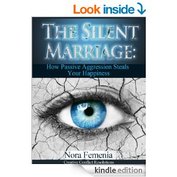
Review of The Silent Marriage by Elizabeth Galen, Ph.D.
Every once in a while, hindsight kicks in and we find ourselves saying, “If only I had known that when…” Today, I had that experience while reading The Silent Marriage: How Passive Aggression Steals Your Happiness. I wish someone had handed me this book ten years ago when my former marriage began have serious problems which ultimately led to its demise. The information in the pages describes the journey I had to walk on my own, learning these truths without a resource guide. While the issues in our relationship were further compounded by the challenges of chronic illness, the basic premise was still the same.

The Silent Marriage is a short Kindle e-book which only cost $4 at the time I ordered it. I have found that the self-published books in this category are often lacking in editing and content. However, I was pleasantly surprised by Nora Femenia and Neil Warner’s work. While the book is not perfect, it is a great place for a woman in a marriage with a passive-aggressive partner to start evaluating what is going on and how she wants to handle it. It’s resource I can see recommending to clients because it is so short and because it is written on a very accessible level for the general population.

The basic information about passive-aggression in the book is based on insecure attachment of the passive-aggressive man to his parents, particularly his mother, when he was a child. This insecure attachment created an avoidant personality wherein the passive-aggressive man seeks love from a spouse while simultaneously emotionally abusing her by pushing her away. His passive-aggressive manipulation is an effort to retain control in a situation where he actually has none: Love is given freely or it is not love. We cannot force people to love us.

My main critique of the book relates to its portrayal of the non-passive-aggressive person in the relationship (usually the wife in this text) as a victim of her husband’s mental disorder. Occasionally it is acknowledged that the wife has an active role in all the relationship, but the emphasis is on the wife not blaming herself for her husband’s behavior. The wife is not a victim, though. She chooses to stay in the relationship, and she contributes to the dysfunction of the relationship in how she responds. I felt like the book really could have done a better job of helping the wife in this situation work on her part of the dysfunction beyond teaching her that she is not responsible for her husband’s emotionally abusive behavior.

Another point of contention for me in this work is the mother-blame which dominates the authors’ theories. If a neglectful or abusive mother raises four children, not all four will become passive-aggressive. Maybe one or two will be based on the families I know with this situation. It’s also possible that the mother is not the primary caregiver and therefore is not the one who created the development of an avoidant insecure attachment in the future passive-aggressive husband. Simply blaming all of the issues on the husband’s mother doesn't allow for the personal responsibility that each of us has in regards to our response to how others treat us. While that response may be partially genetic, partially environmental, and partially related to our fundamental spirit, it’s not entirely the mother’s fault.

The other issue that bothered me in this book was that men are seen as the passive-aggressive partners in the heterosexual marriage. In today’s day and age, it’s time for authors to begin recognizing that not all marriages involve a man and a woman. Furthermore, it’s not always the husband who is the passive-aggressive spouse. I know women who are passive-aggressive, too. I felt as though the authors could have reached a broader audience by examining passive-aggression as a human condition, not one limited to those of a certain sex or gender orientation.

Despite my critiques, I finished this book wanting to read more by the authors to see what other insights they had on passive-aggression. I know that this book will help many women who are trying to understand why their husbands will no longer talk to them, thus creating the silent marriage of the title.

© 2015 Elizabeth Galen, Ph.D., Green Heart Guidance, LLC

1 Comment

Separate Tracks: When Romantic Love Ends

4/2/2015

0 Comments

 
Separate Tracks: When Romantic Love Ends by Elizabeth Galen, Ph.D.
Recently a friend asked me if my ex-husband changed a lot, would I be willing to get back together again with him. The answer to that is no.  Plain and simple. We were once a great couple who met each other’s needs and provided the perfect opportunity for each of us to learn and grow. Our relationship also served the purpose of bringing some really amazing children into the world together. However, that time has passed. We’re now in a place where we have grown in very different directions. 

Several years ago after my ex and I had been separated for about six months, we decided to try a reunion. He had been doing some work on himself, so I felt like I owed him that much. In retrospect, a sense of obligation is really not a good reason to try a reunion. When I told a close friend that my ex and I were trying a reunion, his immediate response was, “You don’t seem very happy about that.”  The only thing I could say to him in response was, “It is what it is.” He had definitely read the situation correctly.  Three days into the reunion, I already knew that the relationship was not going to work out. Everything about the reunion felt wrong to me. It only lasted about a week, and then I came down with influenza, a clear sign that my body wanted nothing to do with this reunion, either. After a little over six weeks, we both agreed it had been unsuccessful. I don’t see that reunion as a failure, though: The experience very clearly taught me that reuniting with him was the wrong thing to do for me on many levels. It helped keep me free of other reunion fantasies as the divorce proceeded. 

In the past decade as my beliefs have changed and grown, I no longer believe that we only have one soul mate. I believe we have many. I also believe that romantic relationships are meant to end eventually. While some of the romantic connections we make may last for an entire lifetime, others are only meant to last for part of our lives. To separate or divorce is not a failure.  It’s simply an acknowledgement that you have completed your journey together and are ready to move on to different challenges. Many times we will unite again with those same lovers in other lives as we continue to share a love and work on issues between us that we haven’t resolved. In this life, I've had the privilege of knowing at least two men whom I was partnered with in past lives. With the one, we are only friends and have no romantic connection in this life. However, we share a soul level love between us that creates a unique and powerful relationship. From this perspective outside romantic love, we've done a great deal of healing work on our past and present lives together. I consider it an amazing blessing to have reunited with him as a friend in this life rather than as a lover.

I'm not alone in these beliefs about romantic relationships not being meant to last forever though the predominant view in our Christian society says otherwise. I recently came across an internet article entitled, “15 Real Marriage Vows I Should’ve Made on my Wedding Day.” By far, my favorite vow is the last which reads, “And if one day we realize that the most loving choice in our marriage is to part ways, to grow in different directions, with different experiences, I promise to be okay with that. While I'll never threaten divorce out of anger or fear, I promise to be honest about the health of our marriage, and to ALWAYS hold love and kindness for you in my heart.” This is a healthy view of romantic relationships that I endorse; I love how the author has phrased it so beautifully.

I still have a soul level love for my ex-husband.  I always will.  He was someone very special to me for a large part of this life.  However, he no longer needs to be in my life in that way.  Our relationship will never return to what it once was.  Even if we wanted it to, there’s no way it could because neither of us are the people we used to be.

© 2015 Elizabeth Galen, Ph.D., Green Heart Guidance, LLC

0 Comments

True Love Doesn’t Always Wait

3/30/2015

0 Comments

 
True Love Doesn’t Always Wait by Elizabeth Galen, Ph.D.
If you want to know God, enjoy the company of lovers. ~Rumi, translated by Coleman Barks

I have an account with many boards on Pinterest that I use for collecting work related articles and pictures.  Because I have boards about relationships and spirituality, Pinterest will often suggest pins to me that are about traditional Christian marriage values.  While I can see where the algorithm is getting the idea these articles might be of interest to me, it couldn't be further from the truth in pinpointing my beliefs.

Lately I’ve been seeing quite a few pins that are variations on the idea that “True Love Always Waits.”  Someone in the Universe must be encouraging me to do some deep healing because this is a very touchy (no pun intended) issue for me based on my personal history. I was raised Catholic and attended an all-girls' Catholic school from grades 6-12. As is required by Catholic teachings, we learned that sex before marriage was a sin. We also learned that boys who pushed us for sex rather than waiting didn't really love us. As young women, we were not expected to actually want to have sex except under pressure from our dates.  These ideas are wrong on so many levels, and in many cases, they are psychologically damaging.

To start with, I do not believe that sex before marriage is a sin.  In my view, sex is an intimate connection between two people. I believe it is sacred, and I believe that it can bring us closer to God.  However, I also believe it can be a lot of fun and can help bond a couple regardless of their marital status. For many people, marriage is no more than a legal piece of paper. It in no way reflects the commitment and love shared by the couple in most cases.  It’s merely a formality for the sake of society.

The idea that sex belongs in marriage began for two different reasons. The first was a male dominated culture that wanted to ensure that the bride was a virgin who would only bear the fruit of her husband’s loins. The second was an attempt to prevent the spread of STDs.  The first is obviously irrelevant in today’s age of genetic testing. The second is still a legitimate concern, though we now have condoms to help with it.

When I was in high school taking a required love and marriage class in my senior year, the concept of sexual compatibility was not even remotely discussed. Sex was presented as having a magic formula of one man and one woman. With a little foreplay thrown in to satisfy the woman, that’s all that a couple needed to have a successful sexual relationship.  The reality of that couldn't be further from the truth. Sex between two amazing people who love each other can still be truly awful if the chemistry is not there or if their sexual preferences are not in alignment with each other. Getting stuck in an unhappy marriage without sexual compatibility is a realistic situation when one believes that sex should not happen until after marriage.  No amount of love or therapy can fix a situation like this.

Another topic that was very much omitted in high school and in our society in general is the idea of women wanting sex: That’s completely healthy and normal. However, if you pay attention to magazine article titles while standing in the checkout line at the grocery store, you’ll quickly notice that our society functions on a misguided belief that all women have low sex drives and all men have high sex drives.  Women aren't supposed to want sex in the same way men do. That means that for women who do want to have sex but are partnered with a man who wants to wait, they can end up feeling like misfits, sexual freaks of nature or undesirable women.

Another common line is that men only want sex for pleasure's sake but that they don’t really love women if they have sex before marriage.  Men wanting sex absolutely doesn't mean they don’t love the women involved.  It means they are human.  When men are wanting sex alone with no emotional involvement or commitment, women may find that situation to be problematic. However, there are a lot of variations between the two extremes.  Finding that fine line of knowing he loves you and wants you for more than just your body is hard, especially when one is young.  However, it’s entirely possible that a man may want to have sex with a woman before marriage to show his love and develop intimacy.

Then there’s that horrible idiom, “Why buy a cow when you can get milk for free?” This line implies that if a woman gives a man sex before marriage, he’ll never marry her.  Aside from the terrible idea of comparing women to farm animals, this saying denigrates both men and women.  Women are not objects to be bought or sold.  Not all men are unable to control their sexual urges nor are they out to just use women for sex.  Many do have good intentions at heart.

In today’s modern world, marriage is not always a viable or practical option. When my ex and I were dating, we were in high school and college; marrying would have meant that we would have lost our health insurance policies through our parents' employers. I have heard of other situations where elderly widows and widowers can’t afford to remarry because they would lose their late spouse’s pension and therefore would not be able to support themselves even meagerly in retirement.  I know another couple who has chosen not to marry because it would cost them tax benefits on the two homes they own, one under each of their names.  Sadly, finances are an important part of survival in our world.

In my own relationship with my ex-husband, the “true love waits” idea was a huge problem for us.  We both grew up Catholic; my ex was far more strict in his moral beliefs than I was, though.  (Ironically, he’s now an atheist.)  He came from a family where sexuality wasn't ever a topic of discussion except to say how wrong sex was before marriage.  Like most young humans, my ex deeply absorbed those views that were being presented to him.  The problem arose when my ex and I had been dating for far too many years to remain celibate (5+ years before we married). There’s no magic number of how long any couple should or shouldn't wait. However, in our case, not having sex actually became very damaging to our relationship after several years even though all those Catholic tales swore that having sex before marriage was the damaging thing. My ex-husband eventually realized much later that his previous views were damaging to our relationship, and he regretted them. His apology during marriage therapy gave me an amazing amount of relief, though it didn't happen soon enough to prevent a great deal of pain in our relationship twenty years earlier.

So what do I teach my children? I have taught them that sex is intimate and powerful. It can be amazing in the right circumstances but it also can be emotionally painful and damaging if it happens in the wrong circumstances. My general belief is that if you’re not willing to deal with the logical consequences of sex (getting pregnant, a realistic risk since no birth control method aside from complete abstinence is 100% reliable), then you shouldn't be having sex. It’s just basic logic to me. Once you’re in a place in your life where you could support and raise a child, then you should wait to have sex with someone who truly cares about you and respects you. That person should see you as a whole person, not just a body to provide physical pleasure. Sex should be a part of an intimate relationship with your partner, an act that brings you closer together regardless of your marital status.

© 2015 Elizabeth Galen, Ph.D., Green Heart Guidance, LLC
0 Comments

Review of The 5 Love Languages

3/10/2015

5 Comments

 
Review of The 5 Love Languages by Elizabeth Galen, Ph.D.
Update 10/25/2019: It's been brought to my attention that Gary Chapman is homophobic and sees LGBTQ+ people as living a "lifestyle" choice. Please know that I in no way endorse those views. I believe all genders and all sexes are natural manifestations of humanity. Despite these horrific views of Chapman, there is validity in his theory of love languages, and love languages can be used and applied in same-sex or other queer relationships.

​**

When my now ex-husband and I were in marriage counseling trying to save our relationship, one of the very useful concepts our therapist introduced us to was The 5 Love Languages:  The Secret to Love That Lasts by Gary Chapman.  At that time, I did not read the book because one does not need to actually read the book to take advantage of the basic concepts of the five love languages.  However, because the concepts had been so important to understanding what had gone wrong in my former marriage, I felt as though I should read the book; I also wanted to use it for a spiritual singles group I am starting in a few months.

Through his years of work as a counselor, Chapman has devised a system of five "love languages" which he has found to be common to all humans regardless of culture.  While the dialects that individuals speak may vary within cultures, the five languages remain the same.  These five languages are (in the order presented in the book) words of affirmation, quality time, receiving gifts, acts of service, and physical touch.  Most of us speak one of these love languages as our primary love language, though occasionally some people are bilingual.  The love language we speak is the main way in which we feel loved, or in Chapman's words, it is how we fill our "love tank."  Unless we are getting our basic needs for love met, we will not be happy in a relationship.  To facilitate the process of discovering our love languages, Chapman provides surveys and other means for readers to determine both their own love languages and the love languages of their partners.

For those whose language is words of affirmation, they have a need to hear their partner verbally express praise, love, and desire.  Those who desire quality time want their partners to spend free time together talking or doing activities of mutual interest.  They want their partners to be truly there for them, disposing of digital devices while they are together in order to focus on each other.  Those who speak the language of receiving gifts want their partners to demonstrate love through presents: They may be expensive gifts or homemade cards depending on the individual and the financial situation.  For those who desire acts of service, doing chores such as sewing buttons on shirts or vacuuming the house are ways to communicate love.  And finally, for those who desire physical touch, they want to feel their partners' hands and bodies touching their own.  How they want to be touched will vary widely by each person's individual dialect.

With regards to my own relationship, we quickly realized that my then-husband was an acts of service person.  He felt that because he was doing the dishes and taking out the trash, he was telling me that he loved me.  I had never remotely viewed those acts as ones of love.  Instead, I viewed them as getting necessary chores done.  For my part, I speak the languages of physical touch and words of affirmation.  I felt that by telling my then-husband how I felt about him and by touching him I was showing him love.  He did not see it that way.  Thus, in the case of my marriage, since I was all but bedbound and no longer able to do acts of service for my husband, he had taken this to mean that I no longer loved him.  Since my husband was rarely touching me or talking to me, I had decided he no longer wanted to be near me or love me.  Clearly our linguistic differences created a huge hiccup in our relationship. 

Chapman correctly points out that we often try to meet our lovers' needs through the language we speak and not the language they speak.  This is where most relationships falter in his opinion.  Instead, what we need to be doing is making a conscious effort to do things for our partners that are spoken in their love languages.  In many relationships, rectifying the differences and working to meet our partners' needs in their languages can resolve the problems the couples are facing.  However, in the case of my ex-husband and me, there were too many other issues outside of the five love languages also contributing to the issues in our relationship.  Just speaking each other’s love languages was not going to solve our issues despite Chapman's belief that solving this crucial issue would help unravel many other problems a couple faces.

One of the largest problems with Chapman's theory is that it will not work for relationships involving narcissists.  Narcissists are individuals whose own needs far outweigh those of their partners (or so they think).  Narcissists only want to make their partners happy if their partners can be happy in ways that primarily meet the narcissists' needs and desires. For example, narcissistic individuals might be willing to take romantic partners to the movie if they express interest in doing so, but the narcissists will only be willing to see movies that they enjoy.  The concept of seeing a movie that their partners enjoy and would make their partners happy is incomprehensible to narcissists.  This extends far beyond seemingly minor things like movie viewing habits:  Narcissists will dictate meal choices, sexual activities, employment decisions, lifestyles, and more. 

Thus, Chapman's idea that if you give more to your partner, then your partner will then get his/her/hir love tank filled and give more in return is ultimately flawed when it comes to narcissists.  In narcissists' worlds, their views and needs are the only ones that matter.  The more that a non-narcissistic partner gives to a narcissist, the more the narcissist will demand.  Narcissists will make their partners' wishes and desires seem unimportant.  In the long run, the only one who will benefit from a system of giving is the narcissist since the narcissist will suck a partner dry long before ever contemplating truly meeting the partner's needs. 

I also felt a great deal of concern in the chapter towards the end of the book where Chapman helps a devout Christian woman to stay in an abusive relationship (quite possibly with a narcissist) using Biblical injunctions since he felt that was the only way to reach this particular woman.  Chapman believes this chapter proves that even an abusive situation can be turned around if the abuser's love tank is full.  I feel that it likely demonstrated that an abused person can be brainwashed into believing that having certain needs met justifies the abuse.

Despite these major holes in Chapman's book and theory, I still feel that The 5 Love Languages is an excellent book that should be recommended premarital reading for all couples; perhaps its contents should even be taught in high schools so that we begin learning from our earliest romantic relationships that it is important to get our own needs met in a relationship while simultaneously meeting the needs of our partners.  Learning the five love languages certainly has changed my view of how I understand relationships, and I believe it can do the same for many others as well.

(I've attached a very detailed list of questions I developed from this book that are meant to be used for a group discussion or for personal journaling.  Feel free to adapt them for your group's needs.)

© 2015 Elizabeth Galen, Ph.D., Green Heart Guidance, LLC

the_5_love_languages_book_group_questions.pdf
File Size: 378 kb
File Type: pdf
Download File

5 Comments

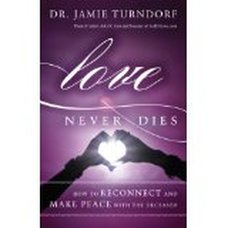
Review of Love Never Dies

2/22/2015

0 Comments

 
Picture
(I received a complimentary copy of this work from Hay House via NetGalley.  The opinions here are my own and are not influenced by anyone.)

I’m a fan of many of the Hay House authors, so seeing that publishing house associated with a new book induces me to try an author I might not have read otherwise.  In most cases, I’m pleased with the selections I read from Hay House.  This was not one of those cases.

In Love Never Dies: How to Reconnect and Make Peace with the Deceased, Jamie Turndorf, Ph.D., explores her newfound connection to the spirit world after the death of her husband, former Jesuit priest Emile Jean Pin.  As a former atheist, this new world of spirituality is an adventure for Turndorf, one she approaches with the blind enthusiasm of a young child after she conquers her initial misgivings.  After her husband’s unexpected death from a reaction to a bee string, Turndorf is surprised to discover her connection to her beloved Jean continues through their deep spiritual love for each other.  She writes that together they have a ministry to help others in processing death and connecting to those in the afterlife so that all involved may continue to grow and heal.

Love Never Dies does have a few good qualities.  It is simply written making it accessible to the popular masses.  The book also has the potential to comfort many in the first and last sections where Turndorf describes her experiences and the experiences of her clients as they reconnect with their deceased love ones.  The book brings up an incredibly large number of questions for a book group to discuss around life, love, healing and death.

From there, however, the book simply falls apart.  It’s repetitive and poorly edited starting with the weak rhyming poetry at the beginning of each chapter.  Turndorf proudly declares that she hadn’t checked out the “competition” before writing her book making it an all original work.  While there are merits to an untainted narrative, those merits are outweighed by the negatives in this book.  Turndorf’s lack of vocabulary to discuss concepts such as synchronicity weakens her arguments and presentation immensely.  The result is a book that feels like an amateur falsely pretending to be a professional.

Turndorf also is blinded by her own narrow experiences regarding the metaphysical world.  She only sees what she wants to see and doesn’t consider that there are possibilities beyond the definitive answers she purports to reach.  For example, Turndorf declares that demons or negative spirit entities might exist though she’s doubtful about it.  She thinks that if negative spiritual beings do exist, Jean protects her from them always.  Any experienced psychic, intuitive or medium who has worked extensively with the metaphysical will cringe at this naïve view:  In his Hay House publication Infinite Quest: Develop Your Psychic Intuition to Take Charge of Your Life, John Edward speaks extensively on the importance of spiritual protection when one is working with the other side.  Turndorf’s inexperience becomes dangerous as she guides readers into murky waters without life jackets.

Furthermore, Turndorf blindly believes that all the departed are willing to work on their faults and help their living loved ones heal.  This, too, is a declaration of an inexperienced practitioner who is, in my words, blinded by the white light.  Other gifted mediums such as me are able to encounter spirits in all their essence, seeing their soul level faults which do not miraculously heal upon entry to the afterlife.  Many souls choose not to work on their own healing in the afterlife, no differently than their course here on earth.  In those cases, Turndorf’s advice risks connecting hurting individuals with souls who will continue to emotionally and spiritual abuse them from the other side.  This is not only ignorant, but it’s dangerous and is the last thing a psychologist should want for clients.

Even on a much simpler and less dangerous level, Turndoff offers bad advice to those wanting to begin meditation as a means to connecting with departed souls.  Setting up beginners with the task of meditating for many hours is going to defeat many people before they even get out of the starting gate.  It’s far better for beginners to slowly introduce themselves to meditation to reduce the risk of perceived failure and to encourage successful future experiences which may eventually be longer.

Turndorf’s faulty logic is so convoluted at times that it is difficult to follow.  Throughout Love Never Dies, she contradicts herself on larger philosophical issues.  Turndorf presents the concept that things that happen more than three times are a scientifically valid result. Unfortunately, she fails to recognize that even if something occurs three times, it’s still possible to misinterpret information about those results.  Throughout the book, I feel she often misinterprets her experiences because of her lack of experience and narrow-minded views.  For example, Turndorf declares many times that we avoid loving fully because losing a loved one is so painful.  However, there are other possibilities for why we might restrain our love that she never even considers.  It’s possible that we don’t love fully because we don’t know how to.  It’s also possible that we don’t love fully because we don’t believe we deserve love.

This narrow perspective continues as Turndorf obsesses over her theories that she is metaphysically gifted because of her premature birth and three month NICU stay away from her mother.  She writes about high fevers and illness predisposing people to being able to being open to spiritual contact, yet she fails to examine the role of her own experiences with Lyme Disease in regards to her metaphysical experiences.  As a practitioner who has had Lyme and who works with many others who have Lyme, I would argue that the vast majority of people who deal with chronic or late disseminated Lyme Disease are those who are metaphysically gifted.  A little research outside of her own bubble would help Turndorf to see these other possibilities. 

As the book progresses, I found Turndorf’s words to her clients and to her readers to be cruel and potentially damaging.  I cringed as Turndorf relates how she said to a newly bereaved parent that “she could view this recent loss as a gift from the spirit.”  While this lesson is true on some levels, the way she phrased this to a parent who has recently lost a baby is heartless at best. 

Furthermore, comparing our pain to others’ is not beneficial.  Telling ourselves “it could be worse” demeans the pain we are experiencing.  Turndorf writes, “When we see someone in pain, we’re being invited to stop feeling sorry for ourselves and give thanks for the problems we have that pale in comparison.  Another person’s difficulty reminds us that we could have it so much worse.”  What she fails to contemplate is that some of her readers (including me in my not so distant past) will fall into that category of having things “so much worse.”  Having been told many times by others that they could look at my life and realize how good they actually have it, I can speak from experience that such an attitude does not help the person undergoing the trials.  The heartless response simply makes their pain increase.

If all of these issues aren’t enough, I found Turndorf’s basic psychological advice to be weak at best.  After 30 years’ experience in practice, she is not a novice.  She earned her Ph.D. in clinical psychology from California Coast University in 1994.  She is a nationally known psychologist using the pseudonym “Dr. Love.”  However, her personal relationship with Jean raised many flags for me as a reader and life coach, beginning with the fact that she was 21 and he was 58 when it began.  Turndorf claims that she and Jean had a perfect spiritual love, yet the aspects of their relationship she shares demonstrate a couple that struggled to love each other in their earthly forms.  She asserts that Jean was “one of the world’s true mystics” but he didn’t know he could be so close to her in spirit form.  This doesn’t build his credibility or hers.  Even Googling her late husband (who died in 2006, after the advent of the internet) does not turn up the abundance of hits one would expect from a man whom she claims was a one of the 50 most holy people to have lived in the eyes of the Dalai Lama.  As she describes their relationship after he “left his body,” Turndorf sees her late husband’s love as fulfilling her and becoming her own love.  Almost all psychologists would argue that seeking to use another’s love as a replacement for self-love is not a healthy approach in the long term.

Finally, in one of the experiences at the end of the book, she details of a client named “Mo.”  Turndorf uses guilt to trick Mo into working with her deceased husband.  This woman clearly has spent a lifetime being manipulated by others who prey on her overactive sense of guilt.  A healthier treatment option might have been to work with Mo to recognize her issues around guilt until she regained the self-esteem necessary to work on herself out of self-love.  The ends did not justify the means in this treatment.

Turndorf seems to think grieving is the only reason people need to connect to Spirit and those on the other side.  As she presents the issues in Love Never Dies, she fails to see how other tragedies can be more devastating and more impactful that grief.  Her narrow-minded and uneducated views result in a book that will help facilitate discussion about important topics but which ultimately may give some very bad advice to vulnerable readers.

(Attached below is a PDF of questions that could be used for book group discussions.  Feel free to alter or edit these questions for your own personal use in a group discussion or journaling.)


© 2015 Elizabeth Galen, Ph.D., Green Heart Guidance, LLC

love_never_dies_book_group.pdf
File Size: 382 kb
File Type: pdf
Download File

0 Comments

Eliminating Emotions

2/15/2015

0 Comments

 
Picture
Problems do not go away. They must be worked through or else they remain, forever a barrier to the growth and development of the spirit.  ~M. Scott Peck

Unexpressed emotions will never die. They are buried alive and will come forth later in uglier ways. ~Sigmund Freud

Walking away from your feelings won’t prevent them from catching up with you.  ~Tina Donovan
 
Like many bloggers, I will check the keywords that people use to find my posts.  Mostly I do it out of curiosity and sometimes amusement, though occasionally a search term can be provocative.  One such recent search was on “eliminating emotions.”  I laughed that Google took someone to my site in search of that answer since my work is very much about dealing with emotions rather than repressing or eliminating them.

In short, it is not possible to eliminate emotions even though that concept might seem incredibly convenient.  We are all born with a mind, body, and spirit connection.  All aspects of us are integrally linked, and there is no way to separate them.    
We store our emotions in our body.  In recent years, organ transplants have become more common and have helped give us a very clear example of stored emotions.  Many of us have heard stories where recipients of organ donations might suddenly find themselves loving baseball when they previously hated sports or craving fried chicken when they were previously a vegan.  This results from the stored emotions of the organ donors.  When the recipients eventually meet the donors’ families, they usually find that their new likes and dislikes are the same as the donors'.

We especially store emotions in times of trauma when we can’t or won’t face them.  I once attended a spiritually oriented Meetup where a man proudly announced that emotions weren’t an issue for him.  He declared that he just stored his emotions in a box and shoved them away.  There was a palpable emotional cringe in the room when he made this pronouncement as so many of the other attendees recognized how unhealthy this man’s solution to emotions actually was.  When we store emotions in a metaphorical box, we are actually shoving them into our body.  There, the emotions fester until eventually they erupt into pain.  In some cases, that pain is actually part of a disease.  As Gabor Maté explains in When the Body Says No: The Hidden Cost of Stress,

Habitual repression of emotions leaves a person in a state of chronic stress, and chronic stress creates an unnatural biochemical milieu in the body… Disease, in other words, is not a simple result of some external attack but develops in a vulnerable host in whom the internal environment has become disordered.
We may think that by ignoring our emotions we are solving our problems in a quick and easy way, but in the long run, we will pay the price.

How these emotions manifest as illness varies widely by the person’s genetics, situation, and spiritual resolve.  There are multiple studies on Chronic Fatigue Syndrome demonstrating a much higher proportion of CFS patients have a history of childhood abuse.   Unfortunately, the media and many health practitioners have misinterpreted that this means that sufferers of Chronic Fatigue Syndrome have simply made up their symptoms as part of a mental illness.  However, CFS is definitely not at all “in one’s head.”  CFS is a result of infections and an adrenal system that has been blown out by years of constant intense stress due to that long-lasting abuse.

Some who have studied the impact of emotions upon the body have found patterns in how emotions manifest into pain and illness.  Heal Your Body by Louise Hay provides a list of the patterns she has seen over the years in how pain presents in many individuals.  This website gives a summary of many of the symptoms and illnesses contained in the book.  In my experience, I find that the book’s contents are often true or very close to the truth for most individuals.  Heal Your Body is a great place to start in trying to determine what emotional and spiritual issues might lie behind your physical pain.

So what do we do about these stored emotions in our body that can cause us pain and illness?  It’s important to clear those stored emotions.  In my personal experience, I find pain relief when I process something that I’ve stored in my body.  It frees me and leaves me happier in the long run.  It can also decrease the symptoms of Post-Traumatic Stress Disorder and general stress.

There are many ways to do clear stored emotions; the best way for one person may not be the best way for another.  Talk therapy is a great way to start, but I’ve found that one usually needs to do something to actively involve the body with the psychotherapy process in order to clear those stored emotions.  Emotional Freedom Technique, EMDR, massage, acupuncture, yoga, craniosacral therapy, and energy work (like I do for my clients) are all great ways to help relieve the stored and festering emotional pain in our bodies.

Emotions may seem pesky.  In my own life, I’ve seen people around me who want to eliminate emotions.  Whenever my ex-husband and I would have a fight, I would experience fibromyalgia flares that would last at least 24 hours.  My ex-husband asked me to get my chiropractor to help me find a way to detach my emotions from my body so that I wouldn’t have to pay a physical price for our marital conflict.  Unfortunately, it just doesn’t work that way.  Our bodies, our minds, and our spirits are intimately linked, and in order to fully heal, we must address all parts of ourselves as an integral unit.

© 2015 Green Heart Guidance
0 Comments

Book Review:  The Enchanted Life of Adam Hope

1/21/2015

0 Comments

 
Picture
To me, one of the definitions of a great book is that after I finish it, I continue thinking about its content and/or characters for days afterward.  The Enchanted Life of Adam Hope by Rhonda Riley (Ecco, 2013) is just such a piece of fiction.  While technically a work of fantasy, this novel is also grounded in some very deep ideas about love and loss.

The Enchanted Life of Adam Hope tells the tale of Evelyn starting from her Great Depression and World War II childhood and continuing to her declining years of life at the end of the 20th century.  Along the way, she negotiates the challenges that many of us face in life.  As a farmer in rural North Carolina, Evelyn experiences quite a bit of independence for a woman.  It is on her farm, inherited from her beloved aunt, that she begins encountering her lovers, both male and female. One of the lovers, Adam, becomes her husband and the main focus of the story.  Together, they find a deep love that many of us strive to find in our lives, filled with intimacy and passion.  They have a large brood of children together, and the tale continues to walk their lives’ journey as parents. 

During the course of the story, Evelyn and Adam must cope with the deaths of both a child and a parent.  Riley’s descriptions of their grief pulled me back to the days and months after the loss of my daughter.  Her words capture the emotions one experiences in such devastating times in a way I’ve never seen so clearly described.  She writes,

Grief is a powerful river in flood.  It cannot be argued or reasoned or wrestled down to a trickle.  You must let it take you where it is going.  When it pulls you under, all you can do is keep your eyes open for rocks and fallen trees, try not to panic, and stay faceup so you will know where the sky is.  You will need that information later.  Eventually, its waters calm and you will be on a shore far from where you began, raw and sore, but clean and as close to whole as you will ever be again.
In particular, Riley relates the intimacy of sex after a loss in a way that I’ve rarely seen discussed nonetheless described so powerfully:
Since [her] death, [Adam had] held himself back in everything, even with me.  Days went by without intimacy.  Then he would turn silently to me in the dark, not out of love but out of need, and there was a fierceness to his touch that overwhelmed me.  We went at each other as if the hounds of hell were after us.  Or we were the hounds themselves. The act was not lovemaking, but grief-making, a new beat manifest, without tenderness, raw and exhausting, throwing us into black, dreamless sleep.
The book branches into fantasy as one of the leads is not human, and yet that plot line helps feed much of the deeper philosophy in the book about our identities.  The questions of what it means to be human, to live, to love, and to die are at the core of the work.  

© 2015 Green Heart Guidance
0 Comments

Changing My Name

12/10/2014

0 Comments

 
Picture
When I was born, I was given the wrong name. It was a name my parents chose carefully, but it was not the right name for me. My first name was my mother’s middle name which was also a multi-generational family name from her side. My middle name was my maternal grandmother’s first name, Elizabeth. My last name was my father’s surname as is the American patriarchal tradition.

Throughout my childhood, I hated my first name. My mother in her warped way always insisted that I had a “beautiful” name and that she wished that people would call her by it rather than her nickname. Even as a child, I always wondered, “If you hate the nickname so much, then why do you introduce yourself by that name? Why not tell people to call you by the full name?” However, my sense of self-preservation knew far better than to say something like that to her.

When I went to college, I went by my given name for the first semester. Then when I returned from winter break, I realized, “Wait. I don’t have to use that name. I can go by any name I want. I can use my middle name.” I think in part it was due to the fact that my maternal grandmother had died a few days before I left for college in August, and so in my mind, the name was now available for use in the family. I wish I’d realized that five months earlier when I first arrived at college, but all in all, it wasn’t a hard transition to make. My friends accepted it, and we moved on with most of them calling me “Beth” though I preferred Elizabeth in the classroom. Family members were a bit more resistant, but most eventually adjusted to the change, and they too started calling me Beth.

Two and a half years later I got married. I hated my first name with a passion by that point, and I was incredibly anxious to drop it. In retrospect, I really wish I had approached the name change differently. If I had to do it again, I would have gotten a legal name change to drop my first name and preserving my maiden name as my last name instead of turning it into my middle name. However, I took my husband’s last name as my own even though I didn’t really like the name and I didn’t feel like I was a part of his family.  The net result was bumping over my names by one to add his last name on the end and drop my first name on the front.

I also had the fanciful notion that I could use all three names without a hyphen. Hillary Rodham Clinton did it somewhat successfully, so surely I could, too. Unfortunately, that wasn’t the reality as I quickly discovered. Most people are lazy and want to drop as many syllables as possible. Thus, a year into the marriage, I adopted a hyphen between my maiden last name and his last name to try to force people to use both names. Sometimes it worked. Often it didn’t. His last name is easier to pronounce than my maiden name, so most people just shortened it to his name even if they didn’t know which was his and which was mine. Speaking with other women who hyphenate, I have found they have the same experience. People decide to pick one name and shorten the hyphenated name without the permission of the owner of the name.

Likewise, I often found that people shortened my first name to “Liz” without my permission. They just decided that my nickname would be Liz. Never mind that Beth, Betsy, Libby, Libba, Eliza, Bess, Bessie, Betty, Bette, Lisa, Ellie, and other names are all nicknames for Elizabeth, too. They picked Liz, and the sound of that name when addressed toward me makes my hair stand on end. I have several friends named Liz, and it doesn’t bother me at all to call them Liz. But calling me Liz? That makes me crazy.  I prefer to be called Elizabeth.

Fast-forward twenty years, and my marriage ended. I was left with the dilemma many women face about what to do with their names after divorce. I didn’t want to keep my ex’s name though he explicitly told me that he could understand why I might want to after having used it for 20 years, and he was ok with that. He also understood how much I didn’t really like the name, so he understood if I didn’t want to keep it.

My kids’ names are hyphenated as mine was, so if I had simply dropped my ex’s last name, then I still would have shared part of their name. That seemed like the logical thing to do. Given the usefulness of Facebook in a situation like this, I changed my name to Elizabeth with my maiden last name on Facebook as a trial to see how it felt. For four weeks I lived with that name, but every time I looked at it, I cringed. I couldn’t stand the idea of going back to it even without my birth first name involved.

At that point, I talked to my therapist, and she agreed with what I had figured out: It was time for a new last name. One that was mine. One that had no ties to any of the men in my life. One that represented my new start and my new life. I spent some time thinking about it, and I decided that I wanted a name that meant “healer” as I feel that my purpose in this life was to heal my own soul and in turn, to help others heal. I got on the internet and Googled names that meant healer, and I began perusing various websites. Once I saw the name “Galen” (pronounced GAY-lin), I was certain that was my new name. It jumped out at me, and there was no other word on the screen that mattered. I briefly contemplated the more feminine “Galena,” but it didn’t feel right to me.

Once again, I switched my name on Facebook to see how it felt, this time to Elizabeth Galen. Every time I saw the name, it made me smile and filled me with joy. It was a name that I loved and that I thought was beautiful. It just felt right. Several friends messaged me over the next few weeks to tell me how much they liked it and how much they felt it suited me. None knew the reasons I had picked it; some assumed that it was actually my maiden name.

The only hurdle left at that point was my kids’ last name being completely different than mine. Since my kids were all old enough (14, 14, and 11) to understand, that helped. I explained to them why I had chosen the name and why I was doing it. My ex and I had actually agreed when the kids were born that if we didn’t get their names right, we would pay for legal name changes for any of them when they turned 18. So I informed the kids of on that agreement, telling them that if they wanted to start casually playing with their last names, that was fine. If they wanted to keep them the same, that was fine. And if they wanted to change their last name to Hermes when they turned 18, that was ok, too. When I was younger, I couldn’t have understood that the bond between my kids and me wouldn’t have been affected at all by us having different last names, but at this juncture, it didn’t even seem a remote possibility that the name change could affect our strong bonds. It is a bit strange filling out forms and having my name be completely different than theirs, but I’m getting used to it.

So now I am Elizabeth Galen; when the divorce was finalized, the name change became legal. Every time I sign my new name, I am filled with gratitude for a name that I love so much.

© 2014 Green Heart Guidance

0 Comments

When Art Imitates Life

12/8/2014

0 Comments

 
Picture
At times, synchronicity can be annoying.  The Universe really likes to drive its message home with me, and there’s no escaping it though I try.  Quite often I find art imitates life as themes seem to bang me over the head until I deal with them or understand what I need to.

One night, I decided to escape the overwhelming metaphysical work I was doing by watching a movie on Netflix.  I found The House of the Spirits which stars Jeremy Irons, Meryl Streep, Glenn Close, Winona Ryder, Antonio Banderas and Vanessa Redgrave.  With an all-star cast like that, how could I go wrong?  The misleading Netflix blurb states, “Esteban vows to marry Rosa, a rich man's daughter. But when Rosa dies before he can save enough money to do so, he instead marries her younger sister.”  What that blurb conveniently left out was the significance behind the “spirits” part of the title.  The younger sister (played as an adult by Glenn Close) is a metaphysically gifted woman who has premonitions and mediumship abilities.  The movie was really excellent, but in trying to escape my metaphysical life, I found myself thrown right back into it again.

Picture
On another evening during my divorce, I decided to watch Crazy, Stupid, Love starring Steve Carell, Ryan Gosling, Julianne Moore, Emma Stone, Marisa Tomei, and Kevin Bacon:  Another film with an all-star cast that I thought would be a chick flick that would give me an escape from reality.  Here at least the Netflix blurb was somewhat accurate as it states, “A middle-aged husband's life changes dramatically when his wife asks him for a divorce. He seeks to rediscover his manhood with the help of a newfound friend, Jacob, learning to pick up girls at bars.”  What the movie description failed to mention is that Steve Carell and Julianne Moore’s characters were high school sweethearts as my ex-husband and I were.  From there, numerous other parallels kept popping up related to the issues we’d faced in our marriage and divorce.  It was far from the sexy escape movie I was hoping for!

When there’s a lesson we need to learn in our lives, sometimes the Universe will take synchronicity into its hands to get us to pay attention.  Seemingly random choices such as movies we select to watch can end up helping us to work through the big picture issues.

©2014 GreenHeartGuidance.com

0 Comments

Giving Thanks

11/27/2014

0 Comments

 
Picturephoto taken at the Lady Bird Johnson Wildflower Center
Each year around this time, many of my friends begin a “30 Days with a Grateful Heart” project that was started by one of the women in the group we all met through.  Through this exercise, these women post on Facebook or on their blogs almost every day in December about something they are grateful for.  In theory, I can see how this is a beautiful way to bring a positive spirit to a season that has been overly commercialized.  In reality, I used to spend the first week of December fighting anger, depression and frustration related to this project.  I was really bothered.  I couldn’t read most of the posts on the topic.  It took me a while to formulate my thoughts on the subject, and I eventually decided that it was something that others need to hear because my outlook is different.  I formulated this post which I originally posted on Facebook for friends several years ago; I've edited and updated it for this blog.  This post definitely isn’t meant as an attack on those who do the project.  Instead, it’s mean to give the perspective of someone who fights major health issues.

For me, living with chronic illness has changed gratitude from something that can be a project that is confined to one month a year.  Gratitude is something that I have to find every single day.  It is a survival skill.  It is what helps me endure the pain and suffering.  In order to keep myself motivated to keep fighting a seemingly uphill battle, I have to count my blessings daily.  I’m not fortunate enough to only focus on these things for a short time each year.  If I lose sight of the things I am grateful for, I will lose the will to keep going.

My health issues also led me to shift the things that I am grateful for.  To those who do gratitude projects at this time of year, please consider adding “health” towards the top of your list of blessings.  If you can go to the grocery store by yourself; if you can go for a walk in the park almost any day of the year; if you can go to your children’s school pageants; if you can attend weddings and funerals; if you can go out with friends to a happy hour; if you can travel near and far; and if your lack of health does not limit the way you live your life, then you are truly blessed in a way that you don’t realize until you lose all of those things.

In the spirit of gratitude, I am going to share my list of things that I am grateful for.  I don’t give thanks for all of them every day, but I do have to find gratitude for some of them 365 days a year.

  • I am grateful for my three living children.  During the worst times of this illness when there was little hope for diagnosis or cure, they were the motivation that kept me alive.  They are amazing humans, and I feel so blessed that the universe has sent them into my life.
  • I am grateful to have only endured the death of one of my children when so many women in the world lose far more of theirs due to natural disasters or preventable problems such as starvation and illnesses borne by poor sanitation.  I hope that my remaining three children are blessed with long, healthy and happy lives.
  • I am grateful for my metaphysical gifts which have greatly advanced my healing at deeper levels than I ever fathomed possible.  Opening to them has changed my lie in ways I never dreamed of in my younger years.  I am so grateful to be able to use them to help others, too.
  • I am grateful for my health care providers who work to improve my overall quality of life.  Through years of working intensely with some of them, they have also become close friends.
  • I am grateful for both drugs and herbs which help me heal.  I am grateful for the current progress we are making with my healing, painful though it may be.
  • I am grateful that I have decent health insurance.  Even though I pay for a large percentage of my health expenses out of pocket, health insurance does cover part of it.  Everyone in the country should be so privileged to have the same or better.
  • I am grateful that I am able to buy organic food.  Eating organic is not a lifestyle choice for me.  It’s a medical necessity.  Food free of synthetic pesticides prevents me from having reactions that include extreme fatigue (even worse than what I normally endure), breathing problems, and fibromyalgia pain among others.
  • I am grateful to have a home where I am safe and able to live healthily.  For many with multiple chemical sensitivities, housing is a huge challenge.  They can’t afford to buy a safe place and finding an affordable safe home to rent is almost impossible.  I am also extremely grateful that the house is still standing and relatively undamaged after a lightning strike in 2009.
  • I am grateful for an ex-husband who is such a loving dad to our kids.  I am grateful for our amicable divorce that was completed this year.  I am grateful for all of the positive changes and growth in my life that came through the divorce.
  • I am grateful for the beautiful new name that I chose during the divorce.  It makes me smile each time I sign it.
  • I am grateful for my intelligence and education.  The disease I am facing requires a large amount of research and action on the part of the patient, and I am able to find and absorb that knowledge.  Without the skills I have, my healing process would not have advanced as far as it has.
  • I am grateful for the good (relatively speaking) health days I have.  Any time I get to go for a walk, go to a park,  go to a farmers’ market, or go to a social event, I feel blessed.
  • I am grateful for all that photography has brought to my life in terms of stress relief and in giving me a new way to look at the world.  I see new things around me that I never noticed before (especially with my beloved macro lens involved!).
  • I am grateful to live in Austin.  Even though I may complain about the heat and allergens and lack of snow, I appreciate the liberal eco-friendly culture that abounds here.  
  • And last but not least, I am grateful for the friends, near and far, who have helped me keep some semblance of sanity throughout all of this.    

© 2014 Green Heart Guidance

0 Comments

What is an Intuitive Empath?

11/11/2014

2 Comments

 
Picture
When I first came out to my friends as metaphysically gifted, it was as an intuitive empath.  So what exactly does that mean?

An intuitive is someone who is guided by higher powers and knows things that s/he could not possibly know otherwise.  Some would use the term psychic instead of intuitive, but I prefer intuitive partially because of some of the negative connotations associated with the term psychic.  I am very much guided by my own intuition as well as the input of higher powers, though one could argue those are the same things.

An empath is someone who can feel others’ emotions in his/her/hir own body.  Arguably, the most famous empath is actually a fictional character, Deanna Troi of Star Trek:  The Next Generation.  Troi used her abilities to sense the emotions in foreign species in order to act as the counselor to the ship’s captain, helping him assess the intentions of those the crew encountered.  Her abilities are presented as fictional and impossible for most humans (as she is half-Betazoid on her mother’s side), but being an empath is a real experience for some humans.

For me, sensing others’ emotions is no different than noticing what color shirt they have on or listening to their tone of voice.  When I walk into a room, it’s part of what I assess unconsciously.  Some argue that this ability develops in individuals as a survival skill, especially in abusive or traumatic situations.  I think that probably combines with a natural disposition toward the ability.  Regardless of how I developed it, it’s something I’ve always done.  I didn’t even realize that it was something that most people didn’t experience until just a few years ago.  When I read Judith Orloff’s Positive Energy at the recommendation of a therapist, I found the book rather boring on one level.  It described how I’ve lived my life all along.  On another level, it was completely enlightening to learn that others didn’t function the way I do and that was causing some of my disconnect from others.  After reading the book, I went to a session of marriage therapy and apologized to my ex for all the times when I thought he was being clueless about things that were so obvious to my perception.

For me, some people are much easier to read than others.  In general, I find men easier to read than women, but even then, there’s quite a bit of variation in how much I sense when I encounter someone.  That amount has to do with my abilities, the metaphysical shields that others have, and others’ relationships to me.  There’s also another wildcard element to it that I don’t fully understand.  It also can sometimes make social interaction with others challenging because I can "see" or feel when a person is lying to me or trying to avoid telling me the truth.

The emotions I feel from others are very visceral and palpable.  It can be as strong as if I were actually experiencing those emotions myself.  When I went to the 5K Austin Gorilla Run a few years ago, I was standing at the beginning of the race and then moved so I could be at the finish line.  The energy was so different at the finish line!  I’ve never been a runner, so I’ve never experienced a runner’s high firsthand, but that feeling coming off the people at the finish line? That was good stuff!  Likewise, the feelings of being around someone who is crazily in love can be very obvious (and happy) to me.

Unfortunately, it’s not just the positive emotions that I experience.  When I am at a zoo or kennel, I can feel the animal’s misery from being held captive.  It makes those really intolerable places for me.  Likewise, when I’m killing off parasites or forcing negative entities to leave, I feel a horrible sensation of panic, and I feel like I want out of my body.  I’ve learned to recognize that it’s not me experiencing that emotion:  It’s the critters in me, and if they’re freaked out about leaving, that’s ok.  They should be.  Their time to go has arrived.  I just have to hold on for a few days and that sensation will pass.

When I first started trying to explain this all to my ex-husband under the supervision of our marriage therapist, he actually was able to give one of the best explanations I’ve heard to date.  He said, “So what you’re telling me is that if you were blindfolded and walked into a room, you could tell me what someone in the room was feeling without reading their body language or facial expressions or vocal tone.”   That’s exactly it.  However, in the real world, I don’t go around blindfolded, so those other elements also do play in quite a bit.  I am not a mind-reader:  Telepathy is not among my gifts, so whatever I am experiencing of other people does not involve what they are actually thinking.  It’s what they are feeling.

An intuitive empath, therefore, is someone who combines the qualities of an intuitive and an empath.  When I am doing metaphysical work as an intuitive, my ability to sense emotions becomes a skill I can use.  In a recent message I received, I could feel the client’s terror about a cooking knife.  I have no idea what that was about, but I knew *I* felt terrified by that knife!  I can also sense the energy of the messengers, too.  Sometimes it’s calm and peaceful; other times it can be incredibly uncomfortable.  In one case, I was speaking with a client’s grandmother.  In our follow up appointment when I politely tried to explain that she felt horribly on edge to me, he replied that she had OCD in life.  That would explain it!  It also helped confirm for him whom I had been communicating with.

As I said, I’ve been this way all of my life, and I can’t imagine being any other way.  I now understand that not everyone is like me, and that’s made it easier to comprehend parts of the world around me.  With that understanding has come more peace about who I am and the way I function.

© 2014 Green Heart Guidance, LLC
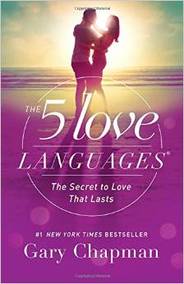
2 Comments

Synchronicity

10/24/2014

0 Comments

 
Picture
Every day is a surprise. There are confirmations of an interconnectivity and synchronicity which inspire, titillate and confirm the inherent comedy of the universe.  ~Billy Zane

We do not create our destiny; we participate in its unfolding.  Synchronicity works as a catalyst toward the working out of that destiny.  ~David Richo

There's no such thing as coincidence, I say. It's synchronicity.  ~Raven Kaldera

What is synchronicity? I would describe it as the love child of "it's meant to be" and "what a coincidence."  Synchronicity is based on the belief that things are orchestrated by a higher power in order for things to happen in a meaningful form.  Things that seem coincidental are actually happening for a deeper purpose.

Synchronicity can play out on a relatively low level.  You and a friend might both show up at a movie theater wearing the same dancing friendly outfit because at the last minute you both independently decided that you wanted to change plans from going to the movies to going dancing.  You might be sitting in a coffee shop and look over to notice the person at the next table has the same casual reading that isn't a recent best-seller.  In such a case, you're probably meant to meet and talk to that person for whatever larger reason.  Perhaps it's your new best friend.

Sometimes synchronicity plays out in a much bigger way.  After my youngest was born, I asked my doula to find me a massage therapist who would do outcall because my body was in a lot of pain.  The woman she sent was nice, and I enjoyed the massage.  Many months later, I saw the massage therapist again at a presentation I was giving on infant loss.  Not long after that, I responded to an ad on Craigslist, and the massage therapist turned out to be the poster.  Then her daughter ended up in the same kindergarten class as my daughter at a charter school.  At that point, I surrendered to the Universe and accepted that this woman and I were meant to be friends.  As we got to know each other, we discovered that had I gone to public high school instead of private, we would have graduated from the same high school in the same year in another state!  Clearly our paths were meant to cross in this life for a higher purpose.

In another instance of paths trying to cross multiple times, I used to love a certain road in the town where my grandparents lived.  When we would visit at Christmas time, I used to love to drive on that road but for no particular reason.  It's just a typical suburban road with homes along it.  I later learned that my boyfriend and eventual husband lived along that road at that time!  Later, as a freshman in high school, I went to an educational summer camp.  My parents decided I would be taking physics though I really wanted to take the pottery class.  It turns out my eventual husband was in that pottery class.  We finally managed to actually cross paths at a youth group at his high school that same fall.

Even Google somehow seems to be tied into higher powers' control of synchronicity, or maybe Google has taken over the higher powers.  Either could make sense!  ;)  During a personal message I received a while ago, I saw a man who looked like John Astin driving a 1950s convertible car on a rural British road.  I did quite a bit of Googling on John Astin, but I couldn't find anything that made any sense with regard to this message.  A few days later, I typed "William Clark" plus a few other search terms into Google as I worked on another part of the message.  One of the first hits was William Clark Gable, known to most of us as the actor Clark Gable.  As I looked at his picture, suddenly everything in the message made sense.  I'd mistaken Clark Gable for John Astin!  Sometimes translating messages is a little too much like playing Pictionary with the other side.  However, I'm grateful for when Google helps me to figure things out.

© 2014 Green Heart Guidance

0 Comments

We Are Not These Diseases

10/1/2014

2 Comments

 
PictureGladiola are believed to raise one's spiritual energy.
After my ex-husband and I separated, many people nosily asked me, “Who had the affair?”  The answer was neither of us.  In my former marriage, Lyme was the unwanted third partner who took the cracks in our relationship and broke them wide open.  All chronic and/or acute diseases like late disseminated Lyme greatly affect the personal relationships the patients have with those around them, sometimes for better and not infrequently for worse.

One of the first things that our marriage therapist made us to come to terms with is the fact that I am not the disease I have.  Though it seems like an incredibly simple idea, it was a hard concept to implement at first for both my ex and me.  I hadn’t realized how much we both had integrated Lyme into my identity.   Once we both grasped that concept, it became easier to release some of the blame that belonged on the disease, not on each other.

In digital Lyme groups that I am a member of, I frequently see the term “Lymies” to refer to those suffering from Lyme disease.  It makes me cringe every time.  Calling those who have Lyme by the name Lymies equates them with their disease.  The idea of “people first” language is not a new one; I remember studying it in a special education class in college in 1992.  The premise is simple:  When referring to a person with a disability or disease, refer to the person first and their disability or disease second.  The man with visual impairment rather than the blind man.  The person with Lyme rather than the Lymie.  The woman who has schizophrenia rather than the schizophrenic.  The person comes before their disease as the person is not their disease, and the person is more important than the disease.  While it might make a sentence wordier, that extra bulk is well worth preserving the individuals’ identity over their disabilities and diseases.

It is vitally important not to identify as the condition you are fighting.  It’s equally important not to call it “your” disease.  Once you taken on that disease as part of your identity, it becomes much easier to lose yourself to the disease.  If you make the disease an integral part of who you are, then that makes it even harder to heal because you would be losing part of your identity in regaining your health.  Identifying yourself as your disease holds you back from being all you can be. 

© 2014 Green Heart Guidance

2 Comments
<<Previous
Forward>>
    Join our newsletter list

    Elizabeth Galen, Ph.D.

    Holistic Life Coach and
    Intuitive Energy Healer

    Categories

    All
    Abuse
    Announcements
    Body
    Body Mind Spirit
    Chronic Illness
    Crystals
    Death
    Disabilities
    Family
    Gender
    General Guidance
    Green Living
    Helping Others
    Holidays
    Infant Loss
    Inspirational Mantras
    Lyme
    Marriage And Divorce
    Meditation
    Metaphysical Gifts
    Mind
    Multiple Chemical Sensitivities
    Narcissism
    Natural Healing
    Nutrition
    Parenting
    Past Lives
    Personal Growth
    Pets
    Popular Culture
    Pregnancy And Childbirth
    Product Recommendations
    Reviews
    Sexuality
    Spirit
    Spirituality And Religion
    Stress Release
    Subsequent Pregnancy After A Loss
    The Other Side
    The Single Life
    Trauma
    World Events

    Archives

    January 2025
    December 2024
    January 2023
    June 2022
    May 2022
    April 2022
    March 2022
    May 2021
    April 2021
    January 2021
    November 2019
    November 2018
    October 2018
    July 2018
    May 2018
    April 2018
    January 2018
    August 2017
    July 2017
    June 2017
    May 2017
    January 2017
    December 2016
    November 2016
    October 2016
    July 2016
    June 2016
    April 2016
    March 2016
    February 2016
    December 2015
    November 2015
    October 2015
    September 2015
    August 2015
    July 2015
    June 2015
    May 2015
    April 2015
    March 2015
    February 2015
    January 2015
    December 2014
    November 2014
    October 2014
    September 2014
    August 2014
    July 2014
    June 2014
    May 2014
    April 2014
    March 2014
    February 2014
    January 2014
    December 2013
    November 2013
    October 2013
    September 2013

    RSS Feed

Services

Green Living
Healing Messages and Intuitive Energy Work
Health Challenges and Chronic Illness
Organic Eating and Food Sensitivities
Pet Psychic Services
Pregnancy and Infant Loss
Remote Home Viewing

About Green Heart Guidance

About Elizabeth Galen, Ph.D.
Contact Elizabeth
Consultation Fees
Client Forms

Social Media

​Facebook
Flickr
Goodreads
Instagram

LinkedIn
Pinterest
Spotify
Twitter
Youtube
Subscribe to GHG's Newsletter